- ECS
- 25 Nov 2026
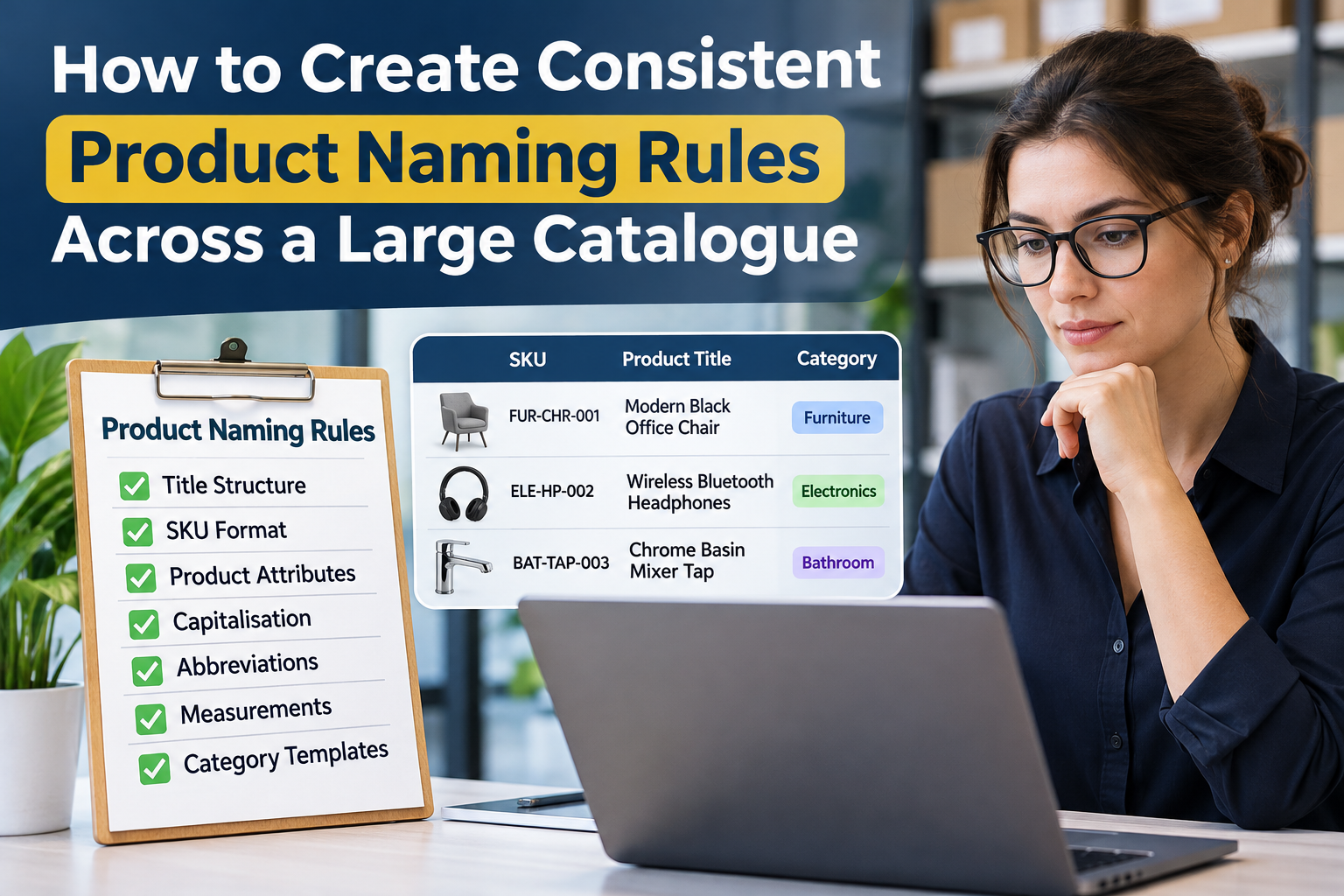
How to Create Consistent Product Naming Rules Across a Large Catalogue
When an eCommerce business manages a few dozen products, maintaining consistent product names is usually straightforward. However, as the catalogue expands to hundreds or thousands of products, small differences in naming can quickly become difficult to manage.
One supplier might describe an item as “Stainless Steel Kitchen Sink”, another might use “SS Kitchen Sink”, while an internal spreadsheet lists it as “Steel Sink – Single Bowl”. These names may refer to the same type of product, but inconsistent wording makes product identification, catalogue management and reporting more complicated.
The problem becomes more noticeable when businesses sell through multiple eCommerce platforms and marketplaces. Product information needs to remain organised even when different channels have their own listing requirements.
Creating clear product naming conventions helps businesses establish a consistent approach to product titles, SKUs, attributes and variations. It also makes it easier for different employees and suppliers to follow the same standards.
In this guide, we explain how to develop practical product naming rules, implement them across a large catalogue and maintain consistency as your product range grows.
1. Understand Why Product Naming Consistency Matters
Product naming is not simply about making titles look professional. It affects how businesses organise, identify, update and distribute product information.
When different teams use different naming styles, several operational problems can develop.
Product Identification Becomes Difficult
Imagine a distributor managing 8,000 products from 15 suppliers. One supplier provides product names with brand information first, another starts with the model number, and a third uses shortened descriptions.
Employees may struggle to identify matching products, particularly when supplier references and internal product codes are also inconsistent.
Duplicate Records Become Harder to Identify
The same product might appear under different names in separate spreadsheets. Without a standard naming structure and reliable product identifiers, duplicate records can remain unnoticed.
This can lead to unnecessary product uploads, inconsistent stock information and additional catalogue maintenance work.
Product Search and Filtering Become Less Useful
Customers expect product information to be clear and easy to understand. If similar products use inconsistent terminology, customers may find it harder to compare items or locate the correct product.
Consistent naming also supports internal search, product categorisation and catalogue organisation. However, naming conventions alone do not guarantee better search rankings or product visibility.
Multi-Channel Product Management Becomes Complicated
Businesses selling through their own websites and marketplaces often need to maintain different listing formats. Without a central naming standard, product information can gradually become inconsistent across channels.
2. Separate Product Titles, SKUs and Product Attributes
One of the most important steps is understanding that product titles, SKUs and attributes serve different purposes. They should follow related but separate naming rules.
Product Titles
A product title describes an item to customers. It should communicate what the product is and include the most useful identifying characteristics.
For example:
- Inconsistent: Black Chair
- Improved: Modern Black Leather Office Chair with Adjustable Height
The improved version provides more useful information without relying on unnecessary promotional wording.
SKU Codes
A Stock Keeping Unit (SKU) is an internal identifier used to distinguish products or individual sellable variants.
For example:
- OFF-CHR-001
- OFF-CHR-002
- OFF-CHR-003
A business might use these codes to distinguish different chair models or variations. The exact structure should reflect its inventory requirements.
SKUs should remain unique within the relevant inventory system. Avoid changing an established SKU simply because a product title has been updated.
Product Attributes
Attributes describe specific product characteristics, such as colour, material, size, dimensions, weight and compatibility.
For example, a furniture catalogue might use:
- Colour: Charcoal Grey
- Material: Solid Oak
- Width: 120 cm
- Height: 75 cm
- Finish: Natural
These values should follow approved terminology and measurement formats.
Businesses that need help organising product specifications can explore product attribute management services.
3. Develop a Standard Product Naming Formula
Once the different types of product information are separated, the next step is to establish a repeatable product title structure.
There is no single formula that works for every industry. A furniture retailer, electronics distributor and fashion brand will have different product information requirements.
However, a general starting structure could be:
Brand + Product Type + Key Feature + Material or Model + Important Specification
For example:
| Industry | Example Product Title |
|---|---|
| Furniture | Oak Dining Table with Natural Wood Finish |
| Electronics | Wireless Bluetooth Headphones with Noise Cancellation |
| Fashion | Men’s Cotton Regular Fit Casual Shirt |
| Bathroom Products | Chrome Wall Mounted Basin Mixer Tap |
| Automotive | Front Brake Disc for Compatible Vehicle Models |
These are illustrative examples. Actual titles should use verified product specifications and relevant customer terminology.
Create Different Templates for Different Categories
Trying to force every product into one naming formula can create unnecessary problems.
For example, an electronics catalogue may need brand, model, product type and technical specification. A clothing catalogue may need gender, garment type, material and fit.
Instead, establish category-specific templates while maintaining consistent formatting rules across the business.
A useful starting point might look like this:
- Furniture: Brand + Product Type + Material + Finish + Dimensions
- Electronics: Brand + Product Type + Model + Key Specification
- Fashion: Gender + Product Type + Material + Fit
- Industrial Supplies: Brand + Product Type + Model + Technical Specification
Not every field needs to appear in every title. Include only information that helps identify the product and supports the relevant sales channel.
4. Establish Clear Rules for Capitalisation, Abbreviations and Measurements
Even when employees follow the same title formula, formatting differences can still create an inconsistent catalogue.
A written naming policy should cover the small details that are often overlooked.
Choose One Capitalisation Style
Decide whether product titles will use title case or sentence case. Apply the chosen style consistently, while preserving official brand names and model references.
For example:
- Inconsistent: Stainless steel Kitchen Sink
- Consistent: Stainless Steel Kitchen Sink
Maintain an Approved Abbreviation List
Abbreviations can save space, particularly when dealing with technical products. However, different employees should not invent their own versions.
Create an approved reference list, such as:
| Full Term | Approved Abbreviation |
|---|---|
| Stainless Steel | SS |
| Right Hand | RH |
| Left Hand | LH |
| Millimetre | mm |
| Centimetre | cm |
Use abbreviations only when they are understood by the intended audience and appropriate for the listing channel. Customer-facing titles may benefit from spelling out certain terms.
Standardise Measurement Formats
Supplier spreadsheets frequently contain different measurement formats. One supplier may provide dimensions in millimetres, while another uses centimetres or inches.
Establish approved units for each product category and retain the original supplier values when necessary for traceability.
For example, a business might standardise furniture dimensions in centimetres while retaining the original measurements in separate source-data fields.
5. Create a Master Product Naming Policy
Written rules are more useful than informal instructions shared between employees. A master naming policy gives everyone a common reference when creating or updating product records.
The document should cover the following areas:
- Approved product title structures for each category.
- Capitalisation and punctuation rules.
- Approved abbreviations and terminology.
- SKU creation and assignment rules.
- Standard attribute names and values.
- Measurement and unit formatting.
- Brand and manufacturer naming requirements.
- Rules for product variations and bundles.
- Marketplace-specific title adaptations.
- Procedures for reviewing and approving changes.
Include good and bad examples for each major category. This makes the policy easier to understand, particularly for new employees and external data entry teams.
Assign responsibility to a specific person or team for approving changes. Otherwise, naming standards can gradually become inconsistent as different departments introduce new products.
6. Standardise Product Names Received from Multiple Suppliers
Supplier data is one of the biggest challenges for businesses managing large catalogues.
Different suppliers often use their own naming structures, product codes and terminology. Some provide complete product descriptions, while others supply only short names and technical references.
For example, three suppliers might describe a similar product as:
- Supplier A: Chrome Basin Mixer Tap
- Supplier B: Basin Tap – Chrome Finish
- Supplier C: Chrome Bathroom Mixer
Before standardising these records, the business must confirm whether they genuinely refer to the same product type and specifications. Similar names alone are not sufficient evidence that two products are identical.
A practical process involves:
- Collecting product information from all supplier files.
- Preserving original product names and supplier references.
- Identifying the relevant product category.
- Mapping supplier terminology to approved business terminology.
- Checking model numbers, specifications and other identifying details.
- Creating standardised product titles.
- Reviewing records for missing information and possible duplicates.
Maintain separate fields for the original supplier title, supplier SKU, internal SKU and approved customer-facing product title. This prevents the standardisation process from removing important source information.
For a related discussion, read how to standardise product attributes from different suppliers.
7. Keep Product Naming Consistent Across Multiple Sales Channels
A business may maintain one master catalogue while publishing product information across Shopify, WooCommerce, Amazon, eBay, Walmart and other marketplaces.
Although the underlying product information should remain consistent, customer-facing titles may need adjustments to meet individual channel requirements.
For example, a business might maintain a master product record containing:
- Brand: Example Brand
- Product Type: Office Chair
- Material: Mesh
- Colour: Black
- Model: OC-250
The master title could be “Example Brand Mesh Office Chair, Black, Model OC-250”. The title published on a particular marketplace may need a different format or length depending on its category rules.
Maintain the following principles:
- Keep one approved master product record.
- Retain consistent internal identifiers.
- Map master attributes to each channel’s relevant fields.
- Adapt customer-facing titles where channel rules require it.
- Check category-specific listing requirements before publishing.
- Record channel-specific changes so future updates remain consistent.
For example, Amazon has specific product title and listing policies, so businesses should check the applicable category guidance rather than assuming that a title accepted on their own website will automatically meet marketplace requirements.
Relevant official guidance is available in the Amazon listing policies.
8. Use Spreadsheets and Bulk Processing to Apply Naming Rules
Manually reviewing thousands of product titles can become difficult and time-consuming. A structured spreadsheet can help businesses apply naming standards systematically before importing information into their eCommerce platform.
A master product data file could contain the following columns:
- Internal Product ID
- Internal SKU
- Supplier SKU
- Original Supplier Product Name
- Approved Product Title
- Brand
- Product Category
- Product Type
- Material
- Colour
- Dimensions
- Product Model
- Validation Status
Use controlled dropdown lists for standardised values, formulas for repeatable formatting and validation rules to identify missing information.
Useful spreadsheet checks include:
- Finding duplicate internal SKUs.
- Identifying blank product titles.
- Flagging inconsistent capitalisation.
- Finding unapproved abbreviations.
- Checking missing mandatory attributes.
- Identifying unusual measurement formats.
Shopify’s official documentation explains how product and variant information is structured in CSV imports. Businesses using Shopify should review the relevant Shopify product CSV documentation before preparing bulk updates.
Businesses handling large imports can also consider professional eCommerce catalogue management support to organise product information, standardise titles and manage ongoing catalogue updates.
9. Review Existing Product Names Before Making Bulk Changes
Applying new naming rules to an existing catalogue requires careful planning. Replacing thousands of product titles without checking their relationships can create additional work.
Start with a catalogue audit rather than immediately changing every record.
A practical review should include:
- Export the existing catalogue: Keep a secure backup of current titles, SKUs, product IDs and variant information.
- Identify naming patterns: Group products by category and find inconsistent title structures.
- Review duplicates: Compare internal identifiers, supplier references and product specifications.
- Prepare standardised titles: Apply the relevant category naming templates.
- Check product relationships: Confirm that parent products and variants remain correctly associated.
- Test a small batch: Review the updated records before processing the remaining catalogue.
- Maintain a change log: Record old and new titles, dates and approval details.
Be particularly careful with URLs, marketplace listings, integrations and historical reporting. A product title change should not automatically trigger an SKU or product identifier change.
10. Maintain Product Naming Standards as the Catalogue Grows
Creating a naming policy is only the beginning. Businesses need a repeatable process to ensure new products follow the same standards.
Consider introducing these ongoing controls:
- New Product Approval: Check every new product title before publication.
- Regular Catalogue Audits: Review existing records for inconsistent naming and duplicate information.
- Employee Guidelines: Make the naming policy available to everyone working with product data.
- Supplier Instructions: Provide standard templates where suppliers submit product information regularly.
- Version Control: Record approved changes to naming templates and terminology.
- Quality Checks: Review a sample of completed records after bulk processing.
Businesses should also review naming rules whenever they introduce new product categories, enter new markets or begin selling through additional marketplaces.
Common Product Naming Mistakes to Avoid
Even businesses with established catalogue processes can develop inconsistencies over time. Some common mistakes include:
- Using different names for the same attribute: For example, using Black, BLK and Jet Black interchangeably without defined rules.
- Mixing SKUs with Product Titles: Internal codes should remain separate from customer-facing descriptions.
- Using One Template for Every Category: Different products require different identifying information.
- Removing Supplier References: Original supplier information should be retained for traceability.
- Changing Identifiers Unnecessarily: Updating a product title should not automatically change its established SKU.
- Ignoring Marketplace Requirements: Each sales channel may have its own product listing requirements.
- Failing to Review Bulk Changes: Large updates should be tested and checked before being applied across the entire catalogue.
Conclusion
Consistent product naming is an important part of managing a large eCommerce catalogue. Without clear rules, different suppliers, employees and sales channels can gradually introduce inconsistent titles, abbreviations, product attributes and identifiers.
The most effective approach is to create category-specific naming templates, maintain approved terminology, separate product titles from SKUs, preserve supplier references and introduce regular quality checks.
Businesses should treat product naming as an ongoing catalogue management responsibility rather than a one-time formatting exercise. A well-documented process makes it easier to add new products, manage existing records and maintain reliable product information as operations expand.