
- ECS
- 06 Apr 1988
Right Time To Outsource Product Data Entry Services
The growth of eCommerce has encouraged many traditional businesses to establish an online presence. From small retailers to large brands, companies are increasingly selling products through their own websites and online marketplaces. However, running an eCommerce store involves much more than setting up a website and adding a few products.
Customers expect accurate product information, clear images, updated prices and a smooth shopping experience. This means online retailers need to keep their product catalogues organised and updated regularly. As the number of products grows, managing these tasks internally can become time-consuming and difficult.
Is it always possible for an in-house team to manage every product update, image upload and catalogue change while handling other business responsibilities?
Not necessarily.
Uploading hundreds or thousands of products requires time, attention to detail and a clear process. Product images also need to be prepared in suitable formats and sizes so they look good without unnecessarily affecting website performance.
This is where outsourcing product data entry services can help. Specialist teams can support businesses with product uploads, catalogue updates, data organisation and other routine eCommerce tasks. Outsourcing can also reduce the workload on in-house employees, allowing them to concentrate on important activities such as customer service, marketing and business development.
Reasons to Outsource Product Data Entry Services
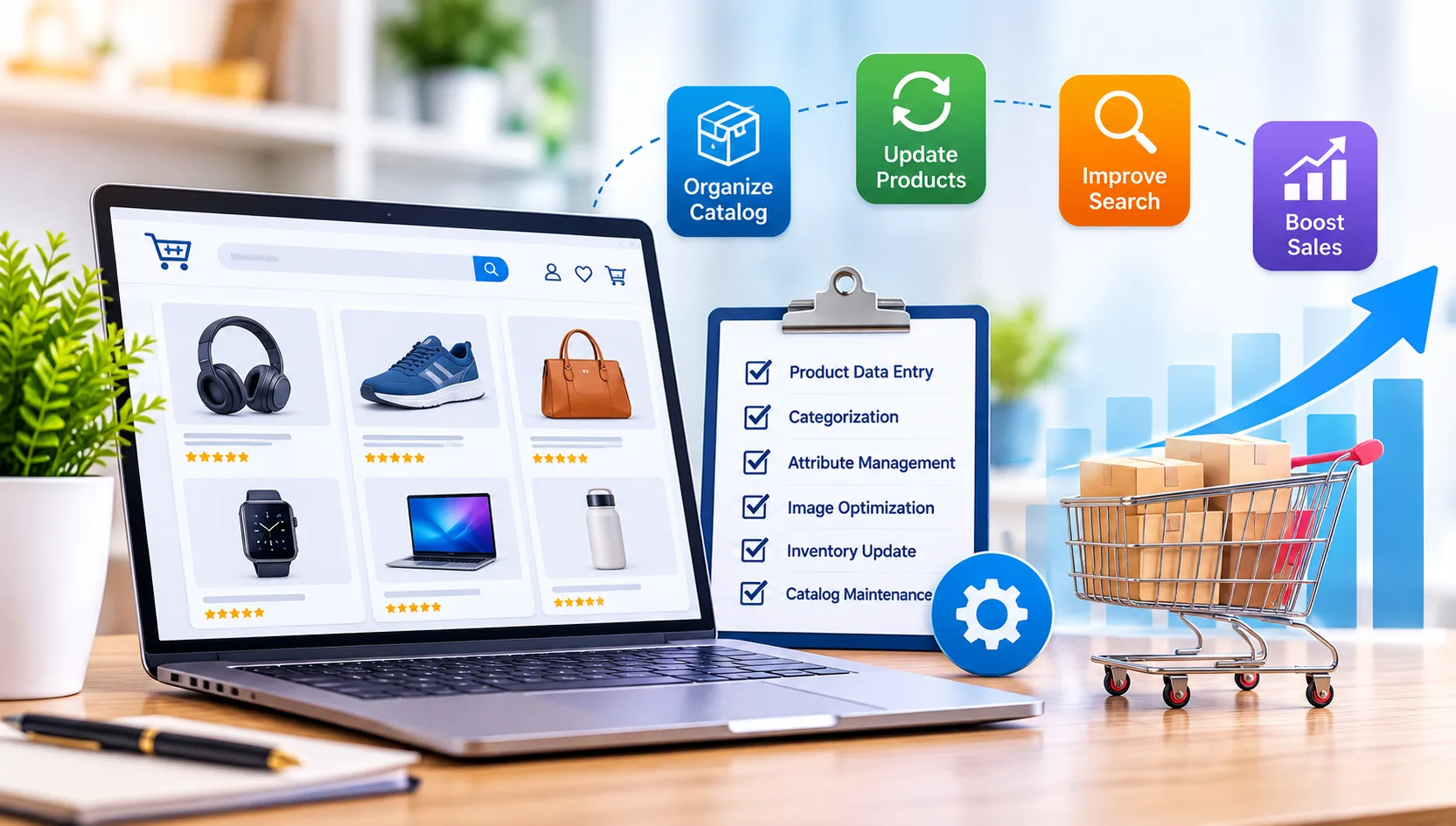
Product data entry professionals can help manage different aspects of an online product catalogue. Depending on the project requirements, their work may include entering product details, uploading images, assigning categories, creating product variations and updating existing listings.
Here are some important reasons why eCommerce businesses consider outsourcing these services.
1. Improve Productivity and Data Accuracy
Adding product information manually can be a repetitive process, particularly when a store has a large inventory. Small mistakes in product names, descriptions, prices, specifications or variations can create confusion for customers and affect catalogue quality.
An experienced product data entry team can follow standard procedures to organise and upload information more consistently.
Outsourcing also allows your in-house employees to spend less time on repetitive catalogue tasks. They can focus on activities that require greater attention, such as improving customer loyalty, developing marketing campaigns and managing business operations.
2. Manage Costs More Effectively
Hiring additional employees to handle product uploads may increase business expenses. Apart from salaries, companies may need to consider recruitment, training, software, equipment and ongoing management costs.
Outsourcing provides another option. Businesses can work with an external team based on their catalogue size, workload and project requirements.
This can be particularly useful for retailers that experience seasonal demand or need help with occasional bulk product uploads. However, the actual savings depend on the service provider, project scope and level of ongoing support required.
3. Access Experienced Product Data Entry Professionals
Product catalogue management requires more than copying information from one document to another. Product attributes, categories, variations, images and platform-specific fields all need to be handled correctly.
An experienced service provider may already have teams familiar with different eCommerce platforms and product data requirements.
Depending on your project, you may receive assistance with:
- Product title and description entry.
- Product image uploading and optimisation.
- Category and subcategory assignment.
- SKU and product attribute management.
- Price and inventory updates.
- Simple and variable product creation.
- Bulk product uploads and catalogue maintenance.
Before choosing a provider, check its experience with your particular platform and product category.
4. Handle Large Product Catalogues More Efficiently
Managing a small number of products is relatively straightforward. However, the workload can increase considerably when a business has hundreds or thousands of listings across different categories or sales channels.
Outsourcing can provide additional support when your existing team does not have enough time or resources to manage the growing catalogue.
A service provider can help organise product information, follow upload procedures and handle repetitive updates. This may be especially useful when launching a new store, adding a large collection or preparing for a seasonal sales period.
5. Get Flexible Support When Business Needs Change
eCommerce workloads are not always consistent. A retailer may need additional help during a product launch, festive season or major catalogue update but have fewer requirements during quieter periods.
Outsourcing can offer flexibility by allowing businesses to arrange support according to their workload.
Instead of immediately expanding the permanent in-house team, you can discuss project-based or ongoing arrangements with a service provider.
This makes it easier to plan resources around actual business requirements.
How to Choose the Right Product Data Entry Service Provider
Choosing an outsourcing company requires careful evaluation. Many providers offer product data entry services, but their experience, processes, security practices and quality standards may differ.
Before making a final decision, consider the following factors.
1. Check Experience with Your eCommerce Platform
Every eCommerce platform has its own features, product fields and upload requirements. A provider experienced with one platform may not automatically understand the workflow of another.
For example, if your website is built using BigCommerce, look for a team familiar with BigCommerce product management and catalogue uploads.
Similarly, businesses using WooCommerce, Magento or Shopify should check whether the service provider has relevant platform experience.
Ask about previous projects, product variation handling, bulk uploads and the tools used to manage product information.
2. Choose a Provider That Understands Your Business Requirements
Product information requirements vary between industries. A fashion retailer may need size charts, colour variations and material details, while an electronics store may require technical specifications, model numbers and compatibility information.
Before outsourcing, explain the nature of your business and the type of information that needs to be entered.
A suitable provider should understand:
- Your product categories and catalogue structure.
- The fields required for each product.
- Image and formatting guidelines.
- Product variations and attributes.
- Your preferred upload process.
- Expected turnaround times and quality standards.
Providing clear instructions from the beginning can reduce errors and avoid unnecessary revisions.
3. Review Data Security and Confidentiality Practices
Product data entry may involve access to your eCommerce dashboard, supplier information, pricing details and other business records. Therefore, data security should be an important part of your selection process.
Ask potential providers about their security arrangements before sharing access to your store.
Check whether they offer:
- Confidentiality agreements where appropriate.
- Restricted user permissions.
- Secure methods for sharing files.
- Clear procedures for handling customer or business information.
- Access controls and account management.
- Data backup and incident-response procedures.
Avoid sharing administrator credentials unnecessarily. Provide only the permissions required to complete the agreed work.
4. Ask About Project Management and Communication
Clear communication is essential when working with an external team. You should know who is responsible for your project, how progress will be reported and whom to contact if an issue arises.
Ask whether the service provider assigns a dedicated project manager or point of contact.
A reliable process should include:
- Clear project requirements and timelines.
- Regular progress updates.
- A method for reporting errors or requesting changes.
- Defined quality-check procedures.
- Agreed delivery and review stages.
Good project management helps both sides understand their responsibilities and keeps the work organised.
5. Evaluate the Tools and Quality-Control Process
Technology can make product data entry faster, but the tools used by a provider should also support accuracy and consistency.
Ask how the team handles bulk uploads, product image processing, spreadsheet management and catalogue validation.
It is also worth understanding how uploaded products are checked before the work is considered complete.
For example, the provider should have a process for checking product titles, descriptions, categories, prices, images, SKUs and variations against the information supplied.
Do not choose a provider based only on claims about using the latest technology. Practical experience, data security, communication and quality control are equally important.
6. Start with a Small Trial Project
Before outsourcing your entire catalogue, consider assigning a small batch of products as a trial.
This gives you an opportunity to evaluate the provider’s accuracy, communication, turnaround time and understanding of your requirements.
Review the completed listings carefully and provide feedback before moving to a larger project.
A trial can help identify potential problems early and make it easier to establish a consistent workflow.
Final Thoughts
Outsourcing product data entry services can be a practical option when managing an eCommerce catalogue becomes difficult for your in-house team. It can help businesses handle bulk uploads, maintain product information and manage routine catalogue updates more efficiently.
However, the right time to outsource depends on your workload, available resources and business priorities. If product uploads are taking time away from more important activities, or your catalogue is becoming difficult to maintain, it may be worth considering external support.
Choose a service provider with relevant platform experience, clear communication, suitable security practices and a reliable quality-control process. A well-managed outsourcing partnership can help you maintain an organised product catalogue while allowing your team to concentrate on growing the business.