- ECS
- 02 May 2022
5 Reasons To Outsource eCommerce Catalog Management Services
The rapid growth of eCommerce has encouraged many traditional retailers to move their businesses online. However, managing an online store involves more than simply uploading products. Whether a business operates on Shopify, Magento, WooCommerce, BigCommerce or another eCommerce platform, maintaining accurate and engaging product catalogues can be a time-consuming task.
Product information, images, descriptions, pricing, specifications and stock details all need regular updates. Since online shoppers cannot physically touch or examine products before purchasing, clear and accurate product listings play an important role in building trust and influencing buying decisions.
Managing these activities in-house can put additional pressure on internal teams, particularly when dealing with large product inventories. This is why many businesses choose to outsource eCommerce catalog management services to experienced professionals.
Outsourcing can help businesses reduce operational costs, improve product data quality and keep their online catalogues organised. Here are five important reasons why outsourcing eCommerce catalog management can be a practical decision.
1. Cost-Effective Solutions
One of the biggest advantages of outsourcing eCommerce catalog management services is cost savings. Hiring and maintaining an in-house team requires investment in recruitment, training, software, infrastructure and ongoing employee management.
Outsourcing to an experienced service provider, particularly in India, can offer access to skilled professionals at competitive rates. Businesses can choose service packages based on their catalogue size and specific requirements rather than maintaining a large permanent team.
This approach helps control operational expenses while allowing internal employees to focus on important business activities such as marketing, sales and customer relationships.
2. Access to Fresh Ideas and Industry Expertise
Professional catalog management teams often work with businesses across different industries, product categories and eCommerce platforms. Their experience gives them a better understanding of product data requirements, listing practices and changing online retail trends.
They can help improve product titles, descriptions, categorisation, attributes and image presentation to make listings more useful and appealing to shoppers.
An experienced outsourcing partner can also suggest practical ways to organise large product catalogues, improve consistency and address common listing problems.
These improvements can give an eCommerce business a competitive advantage while creating a better shopping experience for customers.
3. Access to Advanced Tools and Technologies
Managing thousands of product listings manually can lead to errors, duplication and delays. Professional eCommerce catalog management companies use specialised tools, software and established workflows to handle large volumes of product data more efficiently.
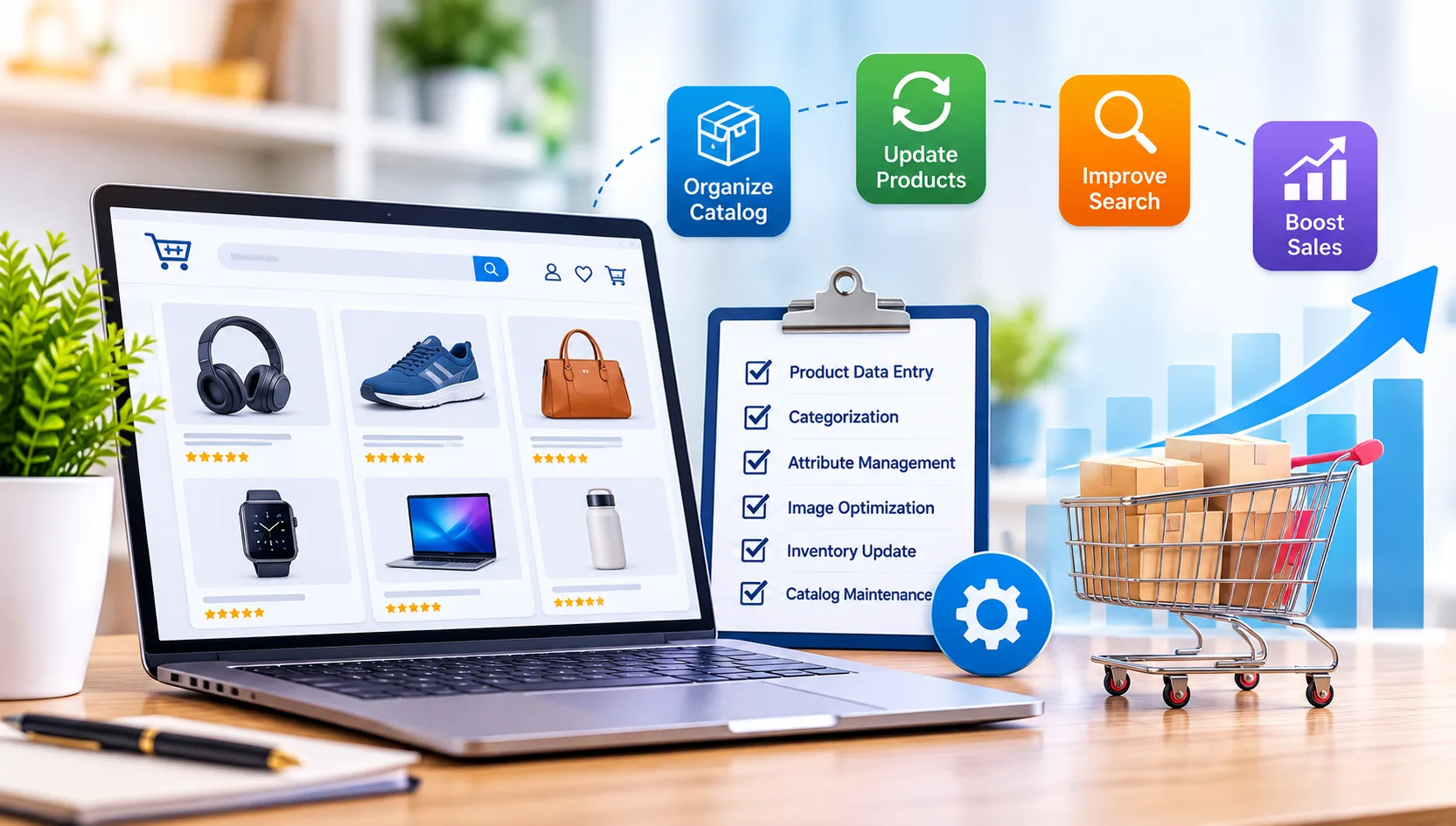
Depending on the project requirements, these tools can help with bulk product uploads, data validation, image processing, product categorisation, inventory updates and catalogue synchronisation.
Working with a technology-equipped outsourcing partner can reduce repetitive manual work and improve the accuracy and consistency of product information.
It also means businesses can benefit from established processes without having to invest in every tool or technology themselves.
4. Reliable Support and Better Communication
Product catalogues require regular attention. New products need to be uploaded, existing listings must be updated and incorrect information should be corrected promptly.
A dependable outsourcing partner can provide dedicated support, regular progress updates and a defined communication process to address these requirements.
Many service providers also offer flexible working arrangements and extended support hours to accommodate businesses operating in different time zones.
Before choosing a provider, businesses should check its support availability, response times, escalation process and quality control procedures. Clear communication helps avoid misunderstandings and keeps catalogue management activities on schedule.
5. Experienced Professionals and Multiple Services Under One Roof
eCommerce businesses often sell products across multiple marketplaces and platforms. Managing different listing requirements can become complicated, particularly when a company operates on its own website as well as marketplaces such as Amazon.
An experienced catalog management provider can offer services across several platforms, including Shopify, Magento, WooCommerce, BigCommerce and Amazon.
Depending on the provider, these services may include:
- Product data entry and bulk product uploads
- Product title and description writing
- Product categorisation and attribute mapping
- Product image editing and optimisation
- Amazon product listing services
- Inventory and pricing updates
- Product data cleaning and validation
- Catalogue maintenance and regular updates
Having access to multiple services through one outsourcing partner can simplify operations and reduce the effort involved in coordinating different service providers.
Final Thoughts
Managing an eCommerce product catalogue requires ongoing attention, accurate information and a well-organised workflow. As product inventories grow, handling everything internally can become expensive and difficult to manage.
Outsourcing eCommerce catalog management services gives businesses access to experienced professionals, specialised tools and flexible support without the need to build a large in-house team.
However, choosing the right outsourcing partner is equally important. Look for relevant platform experience, data security practices, quality assurance processes, transparent pricing and reliable communication.
With the right service provider, businesses can maintain better product catalogues, reduce repetitive workload and spend more time growing their eCommerce operations.